|
|
|
|
Inside Rugged Computer Refurbishment
How used rugged laptops and tablets are tested, restored, graded, and prepared for a second life

Rugged laptops, tablets and handheld computers are designed for long service lives in environments where ordinary consumer and office equipment may not survive. That durability also makes rugged computers particularly interesting candidates for a second life.
That's the business Rugged Books is in. Founded in 2016 and operating from a facility in Niagara-on-the-Lake, Ontario, Rugged Books refurbishes, configures and resells rugged laptops, tablets and handhelds from manufacturers including Panasonic Toughbook, Getac, Dell, Durabook, Zebra and Honeywell. The company also provides repair, deployment, custom configuration and warranty services, and says it has served more than 35,000 customers across six continents.
Why rugged hardware has a secondary market
Consumer electronics and rugged electronics are fundamentally different. They are designed for different purposes, different work environments and often very different expected service lives.
Cost is one obvious consideration. New rugged computers can cost several times as much as conventional consumer or business laptops. That can be justified where reliability, durability and specialized functionality are required, but the cost can make outfitting an entire fleet of vehicles, field workers or warehouse stations a substantial investment. This is where refurbished rugged equipment can provide an alternative.
 Rugged Books says refurbished business and rugged computers commonly sell for 40% to 70% below their original retail price, depending on model, age, configuration and condition. That can allow organizations to deploy genuine rugged hardware where the budget might otherwise only accommodate conventional computers. Rugged Books says refurbished business and rugged computers commonly sell for 40% to 70% below their original retail price, depending on model, age, configuration and condition. That can allow organizations to deploy genuine rugged hardware where the budget might otherwise only accommodate conventional computers.
Unlike most consumer electronics, rugged and enterprise computers also benefit from relatively predictable replacement cycles. Corporate and government fleets are frequently acquired through leasing or scheduled technology-refresh programs lasting three to five years. When those systems are replaced, significant quantities of similar equipment can enter the secondary market at once.
Three to five years doesn't necessarily represent the end of the useful life of a rugged computer. These systems were designed from the start to withstand considerably more physical abuse than ordinary laptops and tablets. Many also have replaceable batteries, storage, memory and other components. Depending on their original use and condition, properly serviced off-lease machines may therefore have substantial useful life remaining. The challenge is determining exactly what properly serviced means.
What does "refurbished" actually mean?
There is no universally enforced standard that defines the term refurbished. In its broadest sense, it generally indicates that a previously used device has been inspected and returned to functional, saleable condition. What happened between those two points can vary considerably.
One seller may thoroughly inspect, test, clean, repair and configure every system. Another may do little more than verify that a computer starts and appears to work. Cosmetic grading terms such as Grade A and Grade B are also widely used, but their precise meaning can vary from one seller to another.
That creates an obvious problem for buyers: two computers described as "refurbished" may have gone through very different processes.
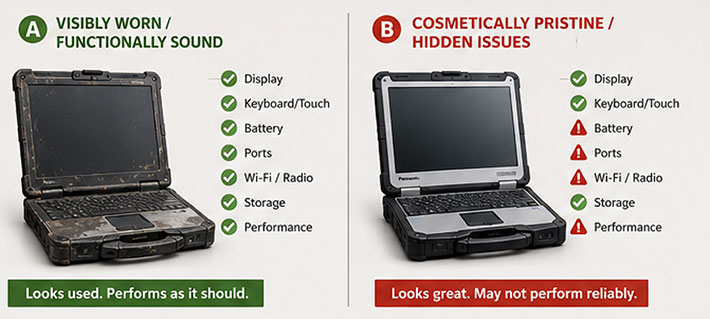
For a rugged computer, appearance alone is an especially poor indicator. A machine with scratches and worn paint may be completely functional after years of field service. Conversely, a cosmetically pristine unit may have a weak battery, damaged connector, unreliable radio or other problem that isn't apparent in a product photograph.
For that reason, the meaningful questions aren't simply whether a computer is refurbished or what cosmetic grade it carries. Buyers should also know what was tested, what constitutes a failure, what was repaired or replaced, how battery condition is evaluated, how data was sanitized, and what warranty or support accompanies the system.
The Rugged Books approach
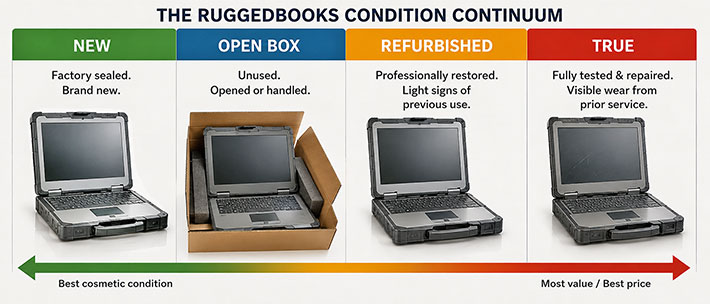
Rugged Books divides the equipment it sells into four categories.
- NEW equipment is factory sealed and unused and carries the full manufacturer warranty.
- OPEN BOX equipment remains in factory condition but has had its packaging opened and has not seen meaningful service use.
- REFURBISHED equipment has gone through the company's refurbishment process and is sold as fully functional, with ports and radios present and working, battery condition meeting the company's stated threshold, and cosmetic condition consistent with light professional use.
There is a fourth category that Rugged Books calls TRUE, for Tested, Repaired, Used Equipment. These systems undergo functional testing but do not carry the same cosmetic expectations as refurbished units. Visible wear, scuffing and finish damage may be present and are reflected in the price.
Rugged Books makes an important distinction between cosmetic and functional shortcomings. A missing or nonfunctional port, for example, isn't considered cosmetic damage and doesn't qualify for the TRUE category. A missing port cover is permitted, but must be disclosed in the individual product listing.
That's actually a useful distinction. Especially with rugged computers, signs of use don't necessarily make a machine unsuitable for continued service. What matters is that the buyer knows what condition to expect and that functional deficiencies aren't hidden behind a lower cosmetic grade.
It's more than just cleaning up old computers
There is also more to putting used enterprise hardware back into service than cleaning it and installing an operating system.
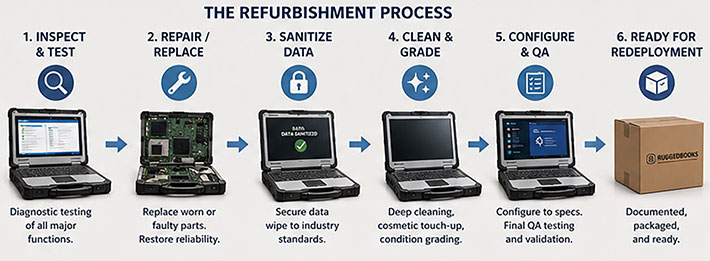
Organizations buying quantities of computers may need a specific OS image, applications, security configuration or other standardized setup. Rugged Books offers repair, customization and deployment services so systems can be configured before shipment rather than individually prepared by the customer's IT department after arrival.
That can be particularly useful for fleet deployments. A utility, public-safety organization, warehouse operation or field-service company may need dozens or hundreds of essentially identical systems. Receiving those machines already configured for their intended application can substantially reduce deployment time.
There is a data-security side to the refurbishment business as well. Equipment coming out of corporate and government fleets may have contained sensitive information, making documented data sanitization an important part of preparing it for another owner.
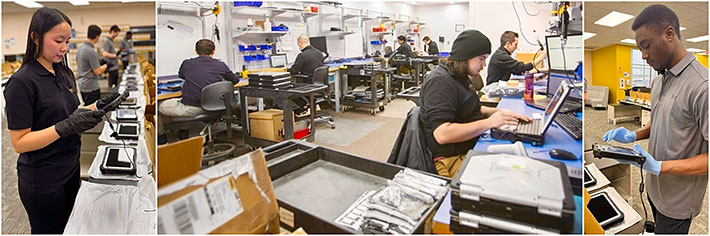
Rugged Books holds R2v3 certification under the Responsible Recycling, Sustainable Electronics Reuse and Recycling Standard. R2v3 covers areas including data sanitization, electronics reuse and recycling, downstream vendor management, and processes for testing and repairing equipment intended for reuse.
 The company also holds ISO 9001:2015 certification for quality management, ISO 14001:2015 for environmental management, and ISO 45001:2018 for occupational health and safety. Rugged Books is a CAGE Code holder and states that it is Section 889 compliant for applicable U.S. government procurement. The company also holds ISO 9001:2015 certification for quality management, ISO 14001:2015 for environmental management, and ISO 45001:2018 for occupational health and safety. Rugged Books is a CAGE Code holder and states that it is Section 889 compliant for applicable U.S. government procurement.
Those certifications don't make one refurbished computer inherently better than another. What they do provide is a documented framework for how equipment, data and processes are handled, with applicable processes subject to external audit.
The environmental argument
There is another obvious benefit to giving rugged computers a second life: the machine doesn't have to be manufactured again.
Computers contain metals, plastics, circuit boards, displays, batteries and numerous other components whose production requires raw materials and energy. Extending the useful life of existing equipment delays its entry into the recycling or waste stream while making further use of the resources and energy already invested in manufacturing it.
Rugged equipment is particularly well suited to that concept. Durability that was valuable during a computer's first deployment doesn't suddenly disappear when an organization's lease expires or its IT department moves to a newer platform.
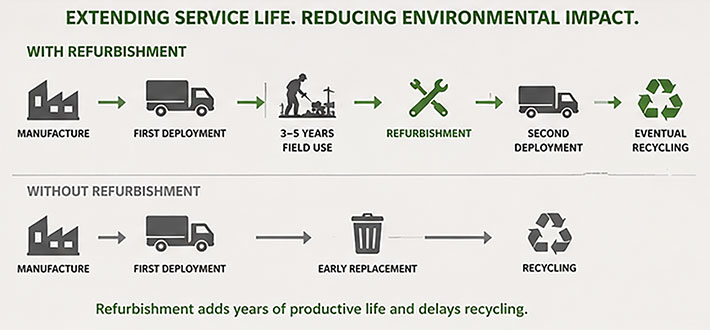
Not every older rugged computer remains suitable, of course. Application requirements change, operating-system support eventually ends, batteries age and newer hardware can offer substantial gains in performance and efficiency. Refurbishment makes the most sense when the capabilities and remaining useful life of the equipment still match the intended application.
Where the secondary rugged market may be headed
Several trends may make the secondary rugged-computer market more important.
First, enterprise and government procurement increasingly emphasizes documented supply chains, data sanitization, regulatory compliance and supplier qualifications. That favors refurbishment operations capable of documenting how equipment was acquired, tested, sanitized and prepared for resale.
At the same time, continuing technology refresh cycles feed relatively recent systems into the secondary market. Organizations may replace computers because of standardized refresh schedules or changing requirements rather than because the equipment has reached the end of its physical life. That means that the meaning of "refurbished" itself may eventually need greater standardization.
For now, the term covers a very broad range of equipment and processes. Clear grading definitions, documented testing and disclosure of functional and cosmetic condition can make the secondary market more transparent for buyers.
For rugged computers in particular, that makes sense. These are machines designed from the outset for durability and long-term field use. A first deployment doesn't necessarily have to be their last. -- Conrad H. Blickenstorfer with Ahmad Nahle, Aug. 26, 2026
Contact
Rugged Books Headquarters
303 Townline Rd Unit #2
Niagara-on-the-Lake, ON L0S 1J0
Canada
|
|